







1 in 8
new small-molecule drugs approved by the FDA from September 2023 to September 2026 carried a QTc-prolongation warning at approval (12 of 94).
Rhizome AI analysis of FDA review documents, September 2026
Clinical Trials & Pharma
Cardiolyse gives sponsors and CROs a device-neutral, CE Class IIa ECG analytics engine for patient identification, risk stratification, treatment-response tracking and cardiac safety read-outs — delivered as a controlled study service with traceable outputs.

Trusted by our commercial and project partners
New medicines still reach approval with QTc warnings. Cardiovascular disease is under-represented in clinical research, yet it is still the leading cause of death in Europe. Consistent, centrally analysed ECG data helps studies characterise cardiac effects and report them with confidence.
new small-molecule drugs approved by the FDA from September 2023 to September 2026 carried a QTc-prolongation warning at approval (12 of 94).
Rhizome AI analysis of FDA review documents, September 2026
of clinical trials between 2017 and 2022 focused on cardiovascular disease, compared with 24% for oncology.
European Society of Cardiology, 2026
deaths across the EU are caused by cardiovascular disease, as are 1 in 5 premature deaths before age 65.
European Society of Cardiology, 2026
The same analysis engine can serve different questions across a programme. Each use is scoped with you, so the outputs match the protocol and the evidence that supports them.
Use ECG findings and risk scores to help find participants who may benefit from a therapy, at screening or from existing datasets.
Group participants by ECG-derived risk, such as the Risk of Heart Disorders score, independently validated for heart failure outcomes.
Track ECG and HRV changes over repeated recordings to follow disease progression and response to treatment.
Rhythm findings and interval measurements, including QT, across every visit — for review by your cardiac-safety team or core lab.
Harmonise historical ECG data from different devices and sites, and re-analyse it with one consistent configuration.
Accept recordings from 1- to 12-lead devices at home or on site — or use a wearable from our device partners.
If you have not chosen an ECG device yet, Cardiolyse can offer a joint solution: a wearable from our device partners, matched to your protocol, plus the analytics behind it — one set-up instead of two separate suppliers.

Beurer handheld ECG devices that participants can use at home for short, repeated recordings — already used with Cardiolyse in home-monitoring programmes and pilots.

Corsano wrist-worn wearables for longer-term remote monitoring, for studies that follow participants continuously between visits.

Compact Movesense body-worn ECG sensors for ambulatory and activity-based recordings, in the clinic or in daily life.
Most programmes begin with a bounded, fixed-scope project on data you already hold. It proves the fit before anything is built into a live protocol.
A retrospective analysis of your existing ECG dataset against a specific development question, with a written report and a QC package.
Protocol-defined ECG analysis for an ongoing or planned study, with the algorithm and configuration locked for the study.
Joint work on ECG-derived biomarkers for a disease area, from exploration on retrospective data to prospective validation.

For most studies, the ECG is a safety checkbox.
We see it as one of the richest signals a trial collects. With consistent, automated analytics, the same recordings that confirm safety can also reveal how a therapy affects the heart.
Every output can be traced back to the recording, the configuration and the algorithm version that produced it.
We agree the question, the ECG data, the outputs and who reviews what — before any processing starts.
The algorithm version and study configuration are fixed and documented for the whole study.
Recordings are quality-checked, analysed and logged. Defined outputs go to independent review where the protocol needs it.
You receive structured exports, reports and the QC and audit package for your statistical analysis.

Clinical research
At the University Medical Center Mainz, the RoHD score predicted worsening heart failure and all-cause death, independently of NT-proBNP and the MAGGIC score.
Read the study summary
Analytics
The ECG-derived risk scores and HRV metrics that can be used as study read-outs.
See the scores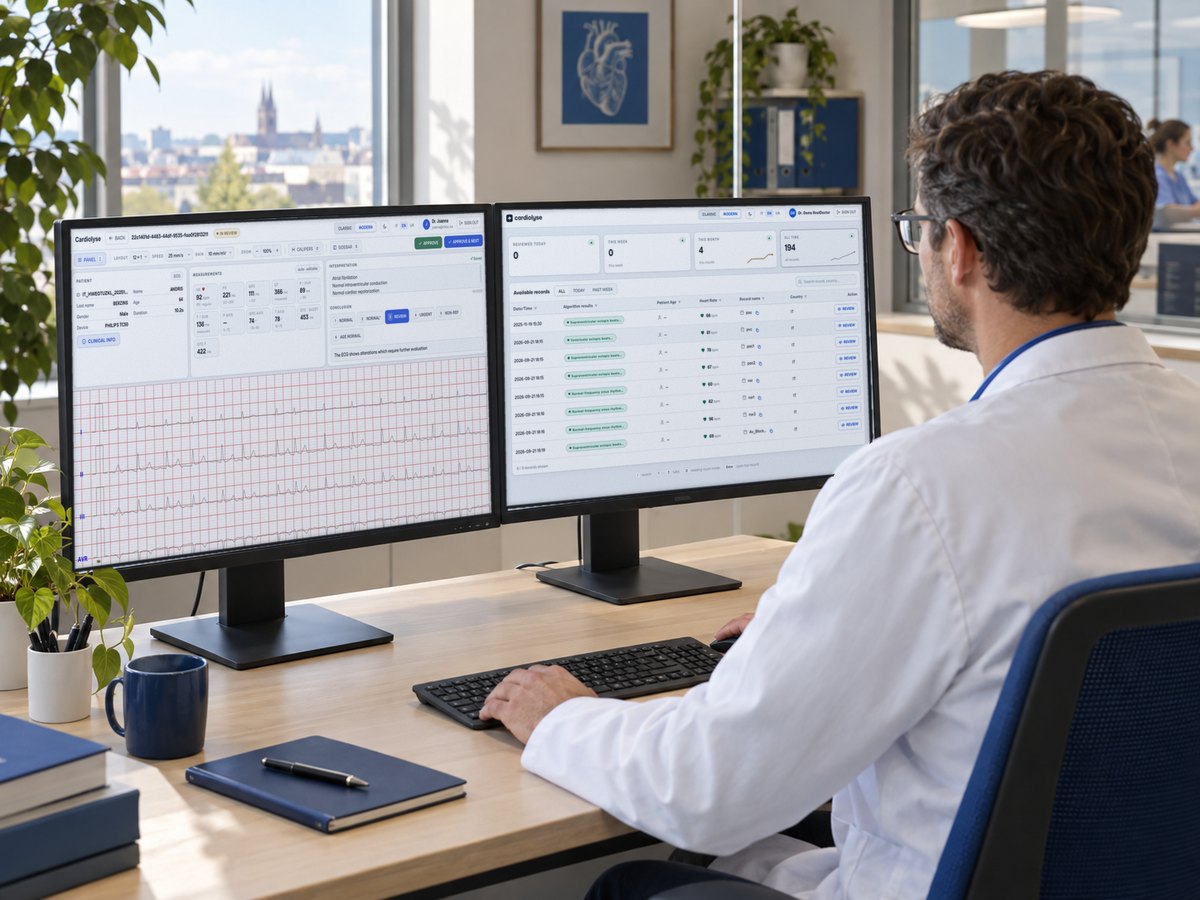
Integration
A documented REST API for batch processing and structured results inside your study systems.
See the APINo. Cardiolyse supplies the ECG analytics, the consistency and the traceability. Your CRO or core lab keeps adjudication, trial-data operations, medical oversight and regulatory submission responsibilities.
Yes. A retrospective feasibility study on an existing, lawfully held ECG dataset is the usual first step. It answers one defined question before any prospective work.
Native digital ECG files are preferred: 12-lead resting ECG, 1- to 3-lead Holter and wearable or patch recordings. Each study defines its supported inputs, and anything outside them is rejected and logged.
Yes. Cardiolyse can offer a joint solution: a wearable from our device partners, such as Beurer, Corsano or Movesense, matched to your study needs, together with the analytics — coordinated as one set-up.
The algorithm version and configuration are locked for the study and documented. Every result is traceable to the source recording and the settings used.
Validation depends on the score and the population. The Risk of Heart Disorders score has independent evidence in heart failure. For other uses, we agree a fit-for-purpose validation plan as part of the study.
Processing runs in the EU with GDPR & HIPAA-aligned data handling and ISO 27001-aligned security, under the data processing terms agreed for the study.
For everything else, see the full FAQ.
Tell us about the study and the data. We will propose a scoped first step.